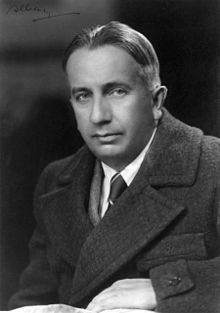
 Alfredo Casella (July 25, 1883 – March 5, 1947) was an influential Italian composer, pianist, conductor, musicologist, and pedagogue.
Queer Places:
Cimitero Comunale Monumentale Campo Verano, Rome, Città Metropolitana di Roma Capitale, Lazio, Italy
Alfredo Casella (July 25, 1883 – March 5, 1947) was an influential Italian composer, pianist, conductor, musicologist, and pedagogue.
Born in Turin into an accomplished musical family—his mother was a skilled pianist and his father and uncles were professional cellists—Casella received his early instruction from his mother. In 1896, at age thirteen, he entered the Conservatoire de Paris, where he studied piano under Louis Diémer and composition under Gabriel Fauré alongside classmates such as Maurice Ravel and George Enescu. During his Parisian years, he became acquainted with Claude Debussy, Igor Stravinsky, Manuel de Falla, Gustav Mahler, Ferruccio Busoni, and Richard Strauss. While a performance of Debussy's Prélude à l'après-midi d'un faune in 1898 left a lasting impression on him, Casella's early compositions, including his First Symphony (1905), remained rooted in the Late Romanticism of Strauss and Mahler. He made his conducting debut leading the premiere of this symphony in Monte Carlo in 1908.
Returning to Italy during World War I, Casella began teaching piano at the Accademia Nazionale di Santa Cecilia in Rome. He rapidly established himself as a central figure in modernizing Italian musical culture, striving to shift attention from traditional opera toward instrumental music and European modernism. In 1917, he founded the Società Nazionale di Musica (later the Società Italiana di Musica Contemporanea), and in 1923, alongside poet Gabriele D'Annunzio and composer Gian Francesco Malipiero, he launched the Corporazione delle Nuove Musiche to promote contemporary Italian works. Together with Malipiero, Ottorino Respighi, Ildebrando Pizzetti, and Franco Alfano, Casella formed the core of the generazione dell'ottanta ("generation of 1880"), a group of post-Puccini Italian composers dedicated to instrumental renewal.
Casella's musical career extended across international performance, composition, and scholarship. From 1927 to 1929, he served as the principal conductor of the Boston Pops. In 1930, he formed the Trio Italiano with violinist Alberto Poltronieri and cellist Arturo Bonucci, touring extensively across Europe and the Americas. His prolific compositional catalog features the ballet La Giara (based on Pirandello's work), the orchestral pieces Italia and Paganiniana, the Concerto Romano, the Partita and Scarlattiana for piano and orchestra, as well as various chamber works, sonatas, and piano compositions like A Notte Alta. Beyond his own writing, Casella played a crucial role in the 20th-century Neoclassical revival and was instrumental in the rediscovery of Antonio Vivaldi's music, organizing the historic Vivaldi Week in Siena in 1939. As a pedagogue and editor, he published authoritative critical revisions of works by Bach, Beethoven, Mozart, and Chopin, and authored pedagogical texts including Il pianoforte (1936) and the treatise La tecnica dell'orchestra contemporanea (co-written with Virgilio Mortari), alongside his autobiography, I segreti della giara. Among his notable students was a young Nino Rota.
Personal ties and intellectual travels also linked Casella to the vibrant artistic circles of early 20th-century Italy. In 1921, he married Yvonne Müller in Paris; their family legacy continued through their granddaughter, actress Daria Nicolodi, and great-granddaughter, actress Asia Argento. Casella was an avid art collector who gathered works by contemporaries such as Giorgio de Chirico, Carlo Carrà, and Filippo De Pisis. His connections with the avant-garde extended to the Italian Futurists led by Filippo Tommaso Marinetti. During visits to the island of Capri—a prominent haven and meeting place for queer, bohemian, and avant-garde intellectuals, artists, and writers during the early decades of the century—Casella traveled with Marinetti and his close friend and collaborator Gian Francesco Malipiero. These visits to Capri placed Casella directly within the cosmopolitan, socially liberated, and LGBTQ-adjacent cultural networks that flourished on the island during that era.
Casella passed away in Rome on March 5, 1947, at the age of 63, leaving behind a lasting legacy as a bridge between 19th-century traditions and 20th-century musical modernism. He is buried at the Campo Verano cemetery in Rome.
References:
 The Seduction of the Mediterranean: Writing, Art and Homosexual Fantasy by Robert Aldrich |
 Capri: Island of Pleasure Hardcover – January 1, 1987 by James Money |
Other references:
Support this project
This website is a passion project researched, developed, and funded entirely by me. If you find the content valuable and would like to help support the ongoing research and hosting costs, any contribution is deeply appreciated.
Thank you for keeping this independent resource alive!
My books on Amazon: Elisa Rolle's books